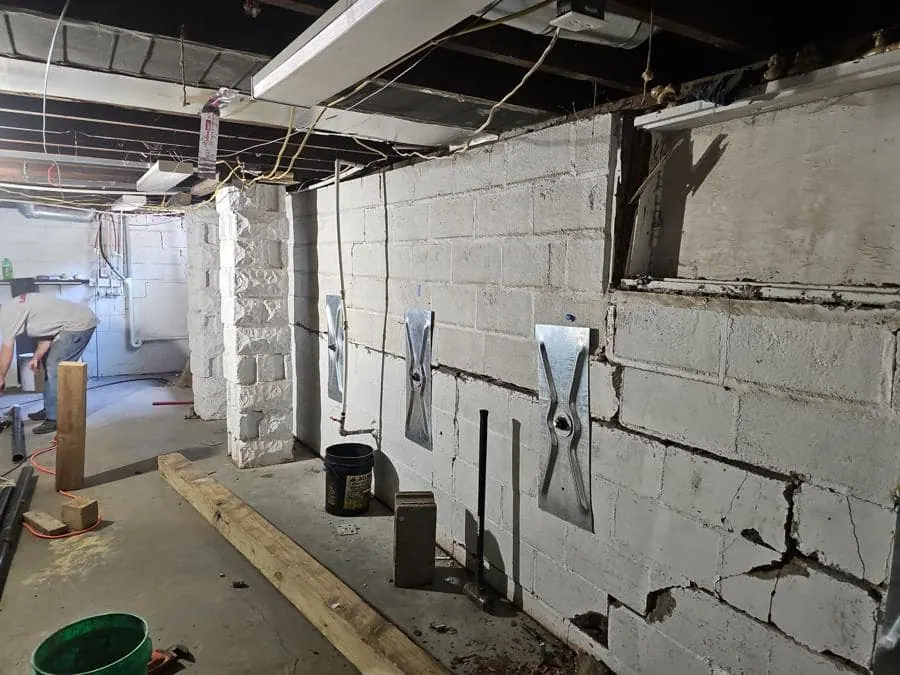
The most expensive signs of foundation problems are the ones you ignore for a year. A hairline crack that costs a few hundred dollars to seal in spring can become a bowing wall that costs five figures by the next freeze-thaw cycle. The good news: foundations almost always warn you first — if you know what you're looking at.
At St. Louis Foundation Repairs, we've spent 30+ years diagnosing foundations across the Greater St. Louis area. Our soil is the problem. The expansive clay under most of this metro swells when it's wet and shrinks hard in a dry July, and that constant push-pull works on a foundation like nothing else. Pair it with our freeze-thaw winters and you get the exact stresses that produce the seven warning signs below. Here's what each one actually looks like — and what's happening underneath when you see it.
Stair-step cracking in exterior brick is one of the clearest signs of foundation problems — St. Louis, MO
Sign 1: Cracks in walls, floors, or exterior brick
Cracks are the most common of all the signs of foundation problems — but not all cracks mean the same thing. The width, direction, and location tell the real story.
- Hairline vertical cracks in poured concrete are often just curing shrinkage and rarely structural on their own.
- Horizontal cracks running across a basement wall are the serious ones — they signal lateral soil pressure pushing the wall inward.
- Stair-step cracks following the mortar joints in block or brick point to differential settlement under one corner of the house.
- Cracks wider than 1/4 inch, or any crack that's visibly growing month to month, warrants an inspection now rather than later.
A good rule of thumb: tape a strip of paper across the crack and date it. If it tears within a few weeks, the crack is active and moving. Our foundation crack repair page breaks down which crack types we seal versus which need structural reinforcement.
Sign 2: Doors and windows that stick or won't close
When a foundation shifts, the framing above it racks out of square — and doors and windows are the first thing to bind. One sticky door in humid weather is normal wood swelling. Several doors across the house jamming at once, especially in dry months, is a structural signal.
- Doors that latch in winter but stick in summer, or the reverse, as the clay soil cycles.
- Visible gaps at the top corner of a door frame where the frame has gone out of square.
- Windows that suddenly need force to open, or won't stay latched.
Re-planing the door is treating the symptom. If the cause is foundation movement, the door will bind again within a season.
Sign 3: Uneven, sloping, or bouncy floors
Floors that slope, dip, or feel springy underfoot are a sign the structure supporting them has moved. You'll often notice it first with a dropped marble that rolls on its own, or a gap opening between the floor and the baseboard.
- Sloping floors usually mean settlement — one part of the foundation has dropped relative to the rest.
- Bouncy or spongy floors over a crawl space often point to failing support posts, rotted beams, or moisture-damaged joists.
- A slope of more than an inch or two over 15–20 feet is well past cosmetic.
This is frequently corrected with foundation piering to lift and stabilize the settled section back toward level.
Sign 4: Gaps between walls, ceilings, and floors
As a foundation settles unevenly, it pulls the structure apart at the seams. Gaps that open between the wall and ceiling, the wall and floor, or around window and door trim are a clear sign the house is no longer sitting square on its footing.
- A wall visibly separating from the ceiling along the top edge.
- Crown molding or baseboard pulling away and leaving a triangular gap.
- Caulk lines around trim that keep splitting open no matter how often you redo them.
These gaps tend to be wider at one end than the other — that taper points toward the corner of the house that's moving.
Sign 5: Water, dampness, or a musty smell in the basement
Water and structural movement feed each other. Hydrostatic pressure from saturated clay pushes on foundation walls, and the same cracks that let that pressure show up also let water in. A persistently damp basement is both a symptom and an accelerant.
- Standing water or puddling after heavy St. Louis rain.
- White, chalky efflorescence on block or concrete — mineral residue left behind by water seeping through.
- A musty smell, peeling paint, or rust stains on stored metal, even when you don't see active water.
Left alone, this leads to mold and wood rot on top of the structural issue. Our basement waterproofing work addresses the water source so the repair holds.
Sign 6: Bowing, leaning, or buckling basement walls
This is the one that should never wait. A wall that bows inward, leans, or shows a horizontal crack across the middle is under active soil pressure and is failing — not at risk of failing eventually, but failing now.
- A visible inward bulge, usually around the wall's mid-height.
- A horizontal crack running the length of the wall.
- Block walls shearing sideways along a mortar joint.
If you can see daylight or feel the wall pushing in, stop storing weight against it and get it looked at immediately. Bowing wall repair with carbon-fiber straps or wall anchors stabilizes it before it collapses.
Sign 7: A chimney pulling away from the house
A chimney often sits on its own footing, separate from the main foundation. When the soil under one settles at a different rate than the other, the chimney tilts or splits away from the wall — a sign of settlement that's easy to spot from the curb.
- A visible gap opening between the chimney and the siding or brick.
- A chimney that leans noticeably off vertical.
- Cracks where the chimney meets the roofline or foundation.
Because a leaning chimney is both a structural and a safety hazard, it's worth an inspection as soon as you notice the lean.
How serious are these signs of foundation problems?
Not every sign means a five-figure repair — but every sign means something is moving, and movement doesn't reverse on its own. The cheapest version of any foundation repair is the one you catch early. A single hairline crack might just need monitoring; that same crack ignored through a few St. Louis freeze-thaw cycles is how small problems become structural ones.
The pattern matters more than any single clue. One sticking door is nothing. A sticking door plus a stair-step crack plus a damp basement corner is a foundation telling you, three different ways, that it has moved. When the signs cluster, that's your cue to get a professional eye on it.
Key Takeaways
- The 7 signs of foundation problems: wall/floor cracks, sticking doors, sloping floors, gaps at walls and ceilings, basement water, bowing walls, and a separating chimney.
- Horizontal cracks and bowing basement walls are the urgent ones — they signal active soil pressure and should be inspected immediately.
- St. Louis expansive clay and freeze-thaw cycles are the root cause behind most local foundation movement.
- Catching the signs early is dramatically cheaper than waiting — schedule a free inspection if any of these look familiar.
What to do if you notice these signs
If you're seeing one or more of these signs of foundation problems anywhere in the Greater St. Louis area, St. Louis Foundation Repairs offers free inspections and no-pressure quotes. With 30+ years of hands-on experience and lifetime transferable warranties on all structural repairs, we tell you what's actually wrong — and what isn't.
Our owner, Kent Schrum, has 30+ years in foundation repair and is personally involved in every project. For more on how foundations move and fail, the USGS overview of expansive soils explains the clay behavior that drives most of what you've read above.
Call us today at (314) 520-9515 or request your free quote online. We serve the entire Greater St. Louis metro area including St. Louis, St. Charles, O'Fallon, Chesterfield, Florissant, Ballwin, Kirkwood, Wentzville, and more.
About the Author
Kent Schrum is the owner of St. Louis Foundation Repairs with 30+ years in foundation repair and structural work. He has personally overseen thousands of foundation repair projects across the Greater St. Louis metro area.
Related: Foundation Crack Repair · Bowing Wall Repair · Foundation Repair FAQs · Recent Projects Gallery
Concerned About Your Foundation?
Free inspections · Honest assessments · 30+ years in the St. Louis area
Filed under:
About St. Louis Foundation Repairs. Family-owned foundation repair and basement waterproofing contractor serving the Greater St. Louis metro since 1992. Owner Kent Schrum has personally overseen thousands of crack repair, waterproofing, piering and concrete lifting projects.
Request a free inspection or call
(314) 520-9515.