Bowing basement walls st louis homeowners notice usually start as a faint horizontal crack about halfway up the wall, then slowly curve inward until the block courses no longer line up. That inward bow is the single clearest sign that the soil outside is winning. Unlike a settling crack, a bowing wall is under active lateral load — and it does not stabilize on its own. The good news: caught early, most walls can be stabilized, and many can be slowly straightened back toward plumb.
At St. Louis Foundation Repairs, we've spent 30+ years repairing bowing basement walls st louis property owners deal with — bowing, leaning, and bulging foundation walls across the metro. The reason it's so common here comes down to one thing under almost every home in the region: heavy, expansive clay.
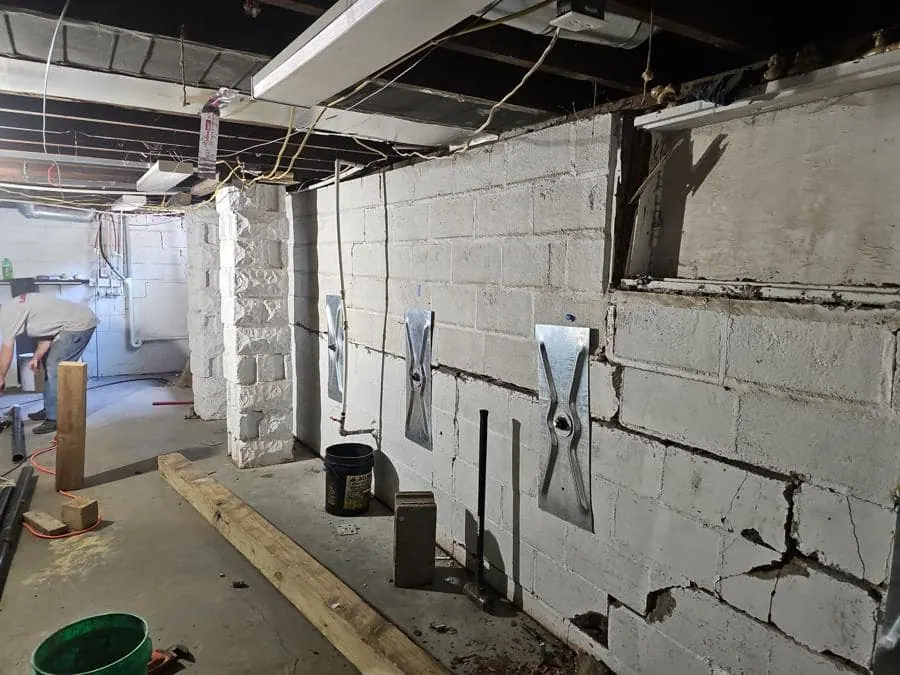
A bowed concrete block wall reinforced with carbon fiber straps in a St. Louis basement.
St. Louis clay soil: the force behind bowing basement walls st louis
The metro sits on some of the most expansive clay in the Midwest — locally called "gumbo." This clay is the root cause behind nearly all bowing basement walls st louis foundations develop. It has a high shrink-swell potential: it soaks up water during our wet spring (April through June carries the heaviest rain of the year here) and swells with enormous force against foundation walls. In summer it dries, shrinks, and pulls away. That seasonal cycle, repeated every year and stacked on top of winter freeze-thaw, is what slowly pushes a straight wall into a bow.
The pressure doing the damage is called lateral hydrostatic pressure — water-saturated soil pressing sideways against the wall below grade. The U.S. Geological Survey documents how expansive soils expand and contract with moisture, generating loads strong enough to crack and displace structural concrete. A poured or block wall is built to carry vertical load from the house above — it is far weaker against this constant sideways shove.
Three things make it worse on a specific home: clogged or missing gutters dumping roof water at the foundation, grading that slopes toward the house instead of away, and a failed or absent drain tile system. Fix the water and you slow the cause; reinforce the wall and you address the damage already done.
How bad is it? Reading the severity of a bowing wall
The repair you need for bowing basement walls st louis homes depends almost entirely on how far the wall has already moved. A rough field guide we use on inspections:
- Under 2 inches of deflection — early stage. Horizontal hairline crack, slight inward curve. Usually a candidate for carbon fiber.
- 2 to 4 inches — moderate. Visible bow, wider crack, sometimes blocks shifting at the joint. Steel beams or anchors typically required.
- Over 4 inches — severe. Pronounced lean, cracked or sheared blocks, possible inward sliding at the base. Heavy-duty stabilization, sometimes partial rebuild.
To track whether a wall is still moving, mark the crack tips with a pencil and date them, or have us set a measured baseline. Movement over weeks confirms active pressure and moves the repair up the priority list. The honest takeaway: a wall at 1 inch today is far cheaper to fix than the same wall at 4 inches next year. Foundation problems never reverse on their own.
Carbon fiber straps: the fix for early bowing basement walls st louis
Carbon fiber is the go-to for bowing basement walls st louis homes show in the early stage — walls that have bowed less than about 2 inches and aren't actively shearing. The straps are an aramid/carbon fabric bonded vertically to the wall with high-strength epoxy, anchored at the sill plate on top and the floor slab at the bottom. Once cured, they're stronger in tension than steel and lock the wall against any further inward movement.
Why homeowners like them: they're low-profile (roughly 1/16" thick), can be painted over, take no floor space, and install in a day with no excavation. The trade-off is that carbon fiber stabilizes — it stops the bow from getting worse but doesn't pull the wall back toward plumb. For an early-stage wall, that's exactly the right tool. For a wall already 3+ inches in, it's not enough on its own.
Vertical carbon fiber straps bonded to a block wall to halt inward movement.
Steel I-beams: the heavy-duty solution for severe bowing
When bowing basement walls st louis homes have moved past the carbon fiber range, steel comes in. Vertical steel I-beams (often called soldier beams) are set against the inside face of the wall, seated into the floor and braced against the floor joists at the top. They physically hold the wall and, by tightening the top connection over time, can gradually coax a bowed wall back toward straight.
Steel handles loads carbon fiber can't and works on walls with significant deflection or cracked block. The downsides: the beams project a few inches into the basement, and the straightening process is gradual — you snug the connections over a season as the soil outside relaxes, rather than forcing the wall and risking a crack. For seriously compromised walls, it's the most dependable option short of rebuilding.
Wall anchors: pulling a bowing wall back from outside
Wall anchors take the opposite approach for bowing basement walls st louis yards can accommodate: instead of bracing from inside, they pull from outside. A steel rod runs from a plate on the interior wall, through the soil, to an earth anchor buried in stable ground beyond the failing zone in your yard. Tightening the interior nut over time draws the wall back toward plumb.
Anchors are excellent for straightening — often the best shot at actually recovering a leaning wall — and they're adjustable, so we can keep working the wall over months. The catch is that they need open, accessible yard space to set the exterior anchors, which rules them out for walls tight against a property line, a driveway, or a neighbor's structure. Where there's room, they're a strong long-term fix.
Comparing the three bowing wall repair options
Here's how the three methods for bowing basement walls st louis repairs line up side by side. Costs are typical St. Louis ranges and vary with wall length, access, and severity — your written estimate after a free inspection will be exact.
| Method | Best for | Stabilize or straighten? | Yard access needed? | Typical cost |
|---|
| Carbon fiber straps | Early bow, under ~2" | Stabilize only | No | $500–$800 per strap |
| Steel I-beams | Moderate to severe bow | Stabilize + gradual straighten | No | $700–$1,000 per beam |
| Wall anchors | Moderate bow with open yard | Best for straightening | Yes | $1,000–$1,500 per anchor |
Most repairs wrap in 1–2 days and don't require leaving your home. During the free inspection we measure the deflection, identify the water source driving it, and give you a written plan with the method matched to your wall — not a one-size-fits-all upsell.
Why waiting makes bowing walls far more expensive to fix
Bowing basement walls st louis homes develop are on a one-way track. The same lateral pressure that produced a 1-inch bow keeps acting every wet season, and the further the wall moves, the more it costs to fix — a few carbon fiber straps on an early wall versus steel beams, anchors, or a partial rebuild on one that's been ignored. Worse, a severely bowed wall can eventually fail and collapse, turning a planned repair into an emergency. There's no version of this problem that gets cheaper by waiting.
If you're seeing the signs of bowing basement walls st louis foundations show — an inward bow, a horizontal crack, or blocks that no longer line up — St. Louis Foundation Repairs offers free inspections and no-pressure quotes. We back all structural repairs with a lifetime transferable warranty. Owner Kent Schrum has 30+ years in foundation repair and is personally involved in every project — we treat every home as if it were our own.
Call us today at (314) 520-9515 or request your free quote online. We serve the entire Greater St. Louis metro including St. Louis, St. Charles, O'Fallon, Chesterfield, Florissant, Ballwin, Kirkwood, and Wentzville.
Key Takeaways
- An inward bow means active soil pressure — it won't stabilize on its own.
- Expansive St. Louis clay and poor drainage are the root cause.
- Severity sets the fix: carbon fiber (early), steel beams (severe), anchors (straightening with yard access).
- Every inch of movement makes the repair more expensive — early is cheap, late is not.
- Get a free inspection the moment you spot a horizontal crack.
Bowing basement wall FAQs
Can a bowing basement wall be straightened, or only stopped?
Both are possible depending on the method. Carbon fiber and steel beams primarily stabilize the wall to halt further movement, while wall anchors and adjustable steel systems can gradually pull a wall back toward plumb over a period of months. The further the wall has moved, the less full recovery is realistic — which is why catching it early matters.
How much does bowing wall repair cost in St. Louis?
It depends on the method and how many supports the wall needs. Carbon fiber straps typically run $500–$800 each, steel I-beams $700–$1,000 each, and wall anchors $1,000–$1,500 each. A full wall might need several supports. You'll get an exact written price after a free, no-obligation inspection — call (314) 520-9515.
Is a bowing basement wall dangerous?
It can be. A bowing wall is under active lateral load, and a severely bowed wall can crack, shear at the base, or in extreme cases collapse. Even before that point, the movement opens paths for water intrusion and structural shifting above. It's not an emergency at the hairline-crack stage, but it is a problem that only worsens with time.
Why do so many St. Louis homes get bowing walls?
The region's expansive clay soil swells when wet and shrinks when dry, pressing sideways against foundation walls with each seasonal cycle. Add heavy spring rain, freeze-thaw winters, and common drainage issues like poor grading or clogged gutters, and St. Louis basement walls face lateral pressure that homes on sandy or rocky soil rarely experience.
About the Author
Kent Schrum is the owner of St. Louis Foundation Repairs with 30+ years in foundation repair and structural work. He has personally overseen thousands of foundation and bowing wall repairs across the Greater St. Louis metro.
Related: Bowing Wall Repair · Foundation Repair FAQs · Customer Reviews · Recent Projects Gallery
Concerned About a Bowing Wall?
Free inspections · Honest assessments · 30+ years in the St. Louis area
Filed under:
About St. Louis Foundation Repairs. Family-owned foundation repair and basement waterproofing contractor serving the Greater St. Louis metro since 1992. Owner Kent Schrum has personally overseen thousands of crack repair, waterproofing, piering and concrete lifting projects.
Request a free inspection or call
(314) 520-9515.