Owning a sump pump in St. Louis means owning your basement's last line of defense against flooding. The pump sits in a pit at the lowest point of your floor and moves groundwater out before it can rise through the slab. When it works, you never think about it. When it fails — usually during the exact storm you needed it most — you find out fast, and the cleanup runs into the thousands.
At St. Louis Foundation Repairs, we've spent 30+ years installing and servicing sump systems across the Greater St. Louis area. Our region's expansive clay soil holds water against your foundation, and our spring and summer storms drop it in volume. That combination is exactly why sump pumps matter more here than in much of the country. This guide walks you through how the system works, the choices that matter, and the simple checks that keep it reliable.
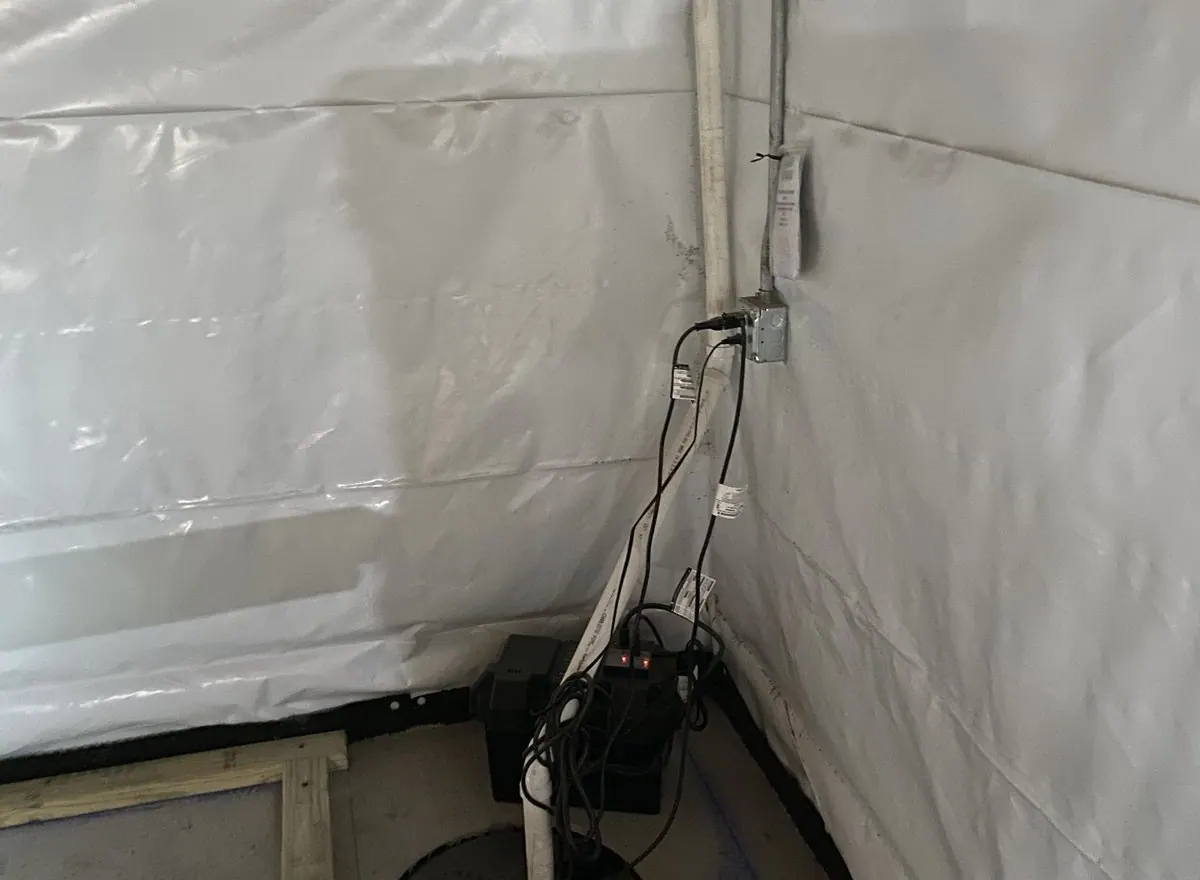
A sump pump paired with a waterproofing membrane system in a St. Louis basement — St. Louis Foundation Repairs, Ellisville, MO
How sump pumps work: Components and installation basics
A sump pump system is simpler than most homeowners expect. Water that collects around or under your foundation is channeled into a pit (the “sump basin”) dug into the lowest part of your basement floor. As water fills the pit, a float switch rises and triggers the pump, which pushes the water up and out through a discharge line that carries it well away from your home.
The core components are:
- Sump basin — the pit, usually 18–24 inches deep, that collects incoming groundwater
- The pump — either a submersible unit (sits in the water, quieter, longer-lasting) or a pedestal unit (motor mounted above the pit, cheaper, easier to service)
- Float switch — the trigger that turns the pump on and off based on water level; the most common failure point in the whole system
- Check valve — a one-way valve on the discharge line that stops pumped water from draining back into the pit
- Discharge line — the pipe that carries water outside, ideally 10+ feet from the foundation and never tied into your sanitary sewer
In most St. Louis basements, the pump ties into an interior drain tile system — perforated pipe installed along the footing that intercepts water before it reaches the floor and routes it to the basin. That's why a sump pump and full basement waterproofing usually go in together: the pump is only as good as the drainage feeding it. A typical installation takes one day; a pump-and-drain-tile combination runs 1–3 days depending on basement size.
For background on protecting your home from water damage, the federal flood-preparedness guidance at Ready.gov is a solid starting point, and the EPA's guidance on basement moisture and mold explains why keeping water out matters well beyond the structure itself.
Primary pumps vs. battery backup systems
Every sump system has a primary pump — the workhorse that runs on household power and handles normal water volume. The mistake most homeowners make is stopping there. A primary pump has two weaknesses: it needs electricity, and it can fail mechanically. In St. Louis, both happen during the same storms that flood basements.
A battery backup pump is a second, independent pump that sits in the same basin and kicks in automatically when the primary fails or the power goes out. It runs off a deep-cycle battery, so it keeps working through an outage. Here's how the options stack up:
- Primary only — fine in a finished, dry season, but leaves you exposed the moment power drops or the pump quits
- Primary + battery backup — the standard we recommend for St. Louis homes; covers outages and primary-pump failure
- Primary + water-powered backup — runs off municipal water pressure with no battery to maintain, but isn't an option on well water and uses a lot of water while running
- Combination units — primary and battery backup engineered as one system, which simplifies install and monitoring
For a typical St. Louis basement, a primary submersible pump plus a battery backup is the configuration that actually protects you when it counts. The added cost is small next to a single flooded-basement claim.
Testing your sump pump: The 5-minute maintenance check
You should test your pump at least twice a year — ideally in early spring before our wet season and again in late summer. It takes five minutes and it's the single best habit for avoiding a failure you didn't see coming.
- Find the pit and remove the lid. Look inside for debris, gravel, or sediment that could jam the float or clog the intake. Clear anything you see.
- Pour in water. Slowly pour 5 gallons into the basin until the float rises. The pump should switch on by itself.
- Watch the pump run. It should pump the pit down quickly and shut off on its own when the float drops. A pump that runs but doesn't move water, or that won't shut off, has a problem.
- Check the discharge outside. Confirm water is actually exiting the discharge line and draining away from the house, not pooling at the foundation.
- Test the backup. If you have a battery backup, unplug the primary pump and repeat the water test — the backup should take over. Then check the battery's age and charge indicator.
While you're down there, glance at the check valve for leaks and make sure the unit is plugged directly into a GFCI outlet, not an extension cord. If anything in this test looks off, don't wait for the next storm to find out what it means.
Learn more about our basement waterproofing services and how we integrate sump systems into a complete dry-basement solution.
Signs your sump pump is failing or undersized
Pumps rarely die without warning. The trick is knowing what the early signals look like so you can replace a failing unit on your schedule, not during a 2 a.m. thunderstorm. Watch for:
- Constant or excessive cycling — the pump turning on and off repeatedly even in dry weather usually points to a stuck float or a faulty check valve letting water flow back in
- Running nonstop — a pump that never shuts off is either undersized for your water volume or has a float that isn't dropping
- Strange noises — rattling, grinding, or loud humming signals a worn impeller, a jammed motor, or debris in the unit
- Visible rust or vibration — corrosion on the unit or excessive shaking shortens its life and signals it's near the end
- It can't keep up — if the pit overflows during heavy rain even though the pump is running, the pump is undersized for your home and St. Louis storm volume
- Age — most sump pumps last 7–10 years. If yours is older and you don't know its history, treat it as borrowed time
- Damp basement despite a working pump — moisture or musty smells with a running pump often means the drainage feeding the pit needs attention, not just the pump
If you're seeing any of these, a free inspection will tell you whether you need a repair, a replacement, or a larger system sized for your actual water load.
Power outage protection: Why every sump pump in St. Louis needs a battery backup
This is the part St. Louis homeowners underestimate the most. The storms that produce our heaviest groundwater — spring thunderstorm lines, summer downbursts — are the same storms that knock out power across the metro. Your primary pump runs on that same grid. So at the exact moment water is pouring toward your basin fastest, your only line of defense can go dark.
A battery backup removes that single point of failure. When the power drops, it switches over automatically and keeps pumping on stored battery charge — typically enough to ride out a multi-hour outage, longer if the primary comes back online intermittently. For homes that have flooded before, or finished basements where a single inch of water means ruined drywall and flooring, it isn't optional.
A few things that make backup protection actually dependable:
- A monitored battery with an audible alarm and charge indicator so you know before the battery is dead, not after
- Correct battery sizing for your typical water volume — an undersized battery drains before the storm passes
- Annual battery testing as part of your spring check; deep-cycle batteries lose capacity and generally need replacement every 3–5 years
When to upgrade: Pump capacity and discharge line considerations
Sometimes the issue isn't a broken pump — it's a system that was never sized for the job. A sump pump in St. Louis has to handle our clay soil and storm volume, and pumps are rated by how many gallons per hour (GPH) they move at a given lift height. A pump that was adequate when your basement was unfinished may be overwhelmed once landscaping changes, a wetter pattern, or a finished basement raise the stakes. Consider an upgrade when:
- The pit fills faster than the pump empties it during heavy St. Louis rain — the clearest sign you need more capacity
- You've finished the basement and the cost of a flood just went up dramatically
- Your discharge line is too short — dumping water within a few feet of the foundation lets it cycle right back to the basin; it should run 10+ feet out to grade
- The discharge freezes in winter, backing water up into the basin — a frost-resistant discharge design solves this
- You're still on a single primary pump with no backup — the most common and most worthwhile upgrade
If you're dealing with any of these anywhere in the Greater St. Louis area, St. Louis Foundation Repairs offers free inspections and no-pressure quotes. With 30+ years of hands-on experience and lifetime transferable warranties on our structural repairs, we'll size the system to your home and our climate — not to a generic spec sheet.
Our owner, Kent Schrum, has 30+ years in foundation repair and basement waterproofing and is personally involved in every project. We treat every home as if it were our own.
Call us today at (314) 520-9515 or request your free quote online. We serve the entire Greater St. Louis metro including St. Louis, St. Charles, O'Fallon, Chesterfield, Florissant, Ballwin, Kirkwood, and Wentzville.
Key Takeaways
- A sump pump only works as well as the drain tile feeding it — pump and waterproofing go together
- A battery backup is essential in St. Louis because storms that flood basements also knock out power
- Test your pump twice a year with the 5-minute water test — spring and late summer
- Most pumps last 7–10 years; constant cycling, nonstop running, or noise are early failure signs
- Schedule a free inspection if your pump can't keep up or you have no backup
About the Author
Kent Schrum is the owner of St. Louis Foundation Repairs with 30+ years in foundation repair and basement waterproofing. He has personally overseen thousands of waterproofing and sump system projects across the Greater St. Louis metro area.
Related: Basement Waterproofing · Foundation Repair FAQs · Customer Reviews · Recent Projects Gallery
Worried About Your Sump Pump?
Free inspections · Honest assessments · 30+ years in the St. Louis area
Filed under:
About St. Louis Foundation Repairs. Family-owned foundation repair and basement waterproofing contractor serving the Greater St. Louis metro since 1992. Owner Kent Schrum has personally overseen thousands of crack repair, waterproofing, piering and concrete lifting projects.
Request a free inspection or call
(314) 520-9515.